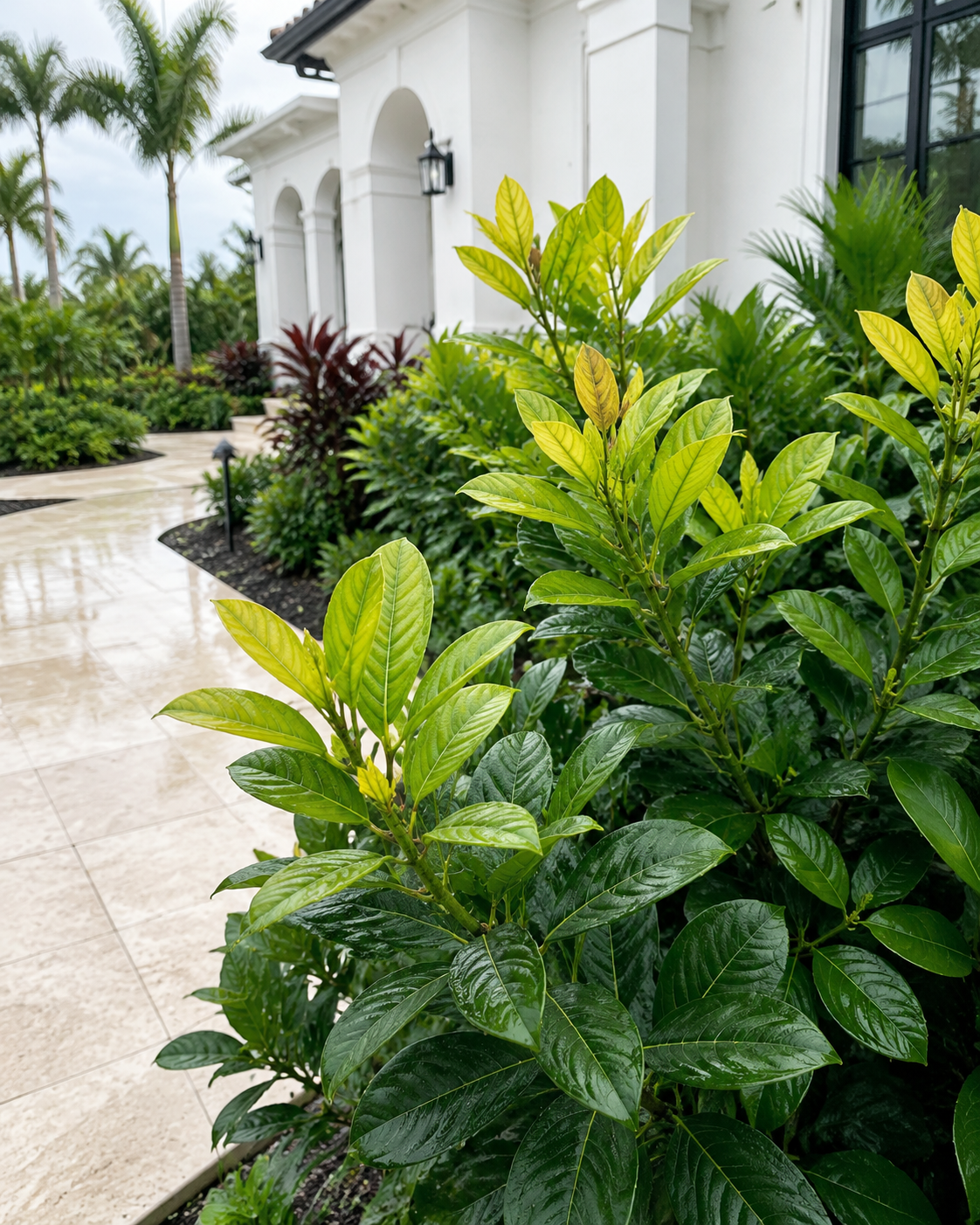
During the Gulf Coast rainy season, alkaline soil, saturated roots, deep planting, root injury and irrigation-water quality can prevent a plant from absorbing nutrients that are already present. More fertilizer may waste money, violate local restrictions or increase stress.
Start with the affected foliage
- Newest leaves first: often associated with iron, manganese or other micronutrient availability.
- Oldest leaves first: may involve mobile nutrients such as nitrogen, magnesium or potassium.
- Entire plant: consider irrigation, root damage, saturation, salinity or a broader nutrient problem.
- One branch: consider localized root or stem injury.
These are clues—not proof. Nutrient disorders, root diseases and environmental stress can overlap.
Why Gulf Coast sites create this problem
Alkaline soil
Iron, manganese, zinc and boron become less available to many plants as pH rises. Coastal limestone, shell, concrete, stucco residue, fill and high-pH water can create alkaline conditions.
Saturated roots
Roots require oxygen. Soil that remains saturated after heavy rain may limit uptake even when nutrients are present.
Planting depth and water quality
Buried crowns and deep mulch reduce oxygen. Coastal well water and some irrigation sources can also influence pH or salinity.
What homeowners can inspect
- Identify whether symptoms begin on new growth, old growth or the whole plant.
- Photograph whether veins remain green between yellow tissue.
- Compare healthy and affected locations.
- Check moisture below the mulch surface.
- Look for buried trunks, crowns or excess mulch.
- Note concrete, shell, limerock, fill or construction.
- Run the irrigation zone and document recent flooding or changes.
Test before treating
Collect affected and healthy areas separately for soil testing. For valuable plants or persistent problems, tissue analysis may be useful because soil results do not always show what the plant is absorbing.
What not to do
- Do not apply complete fertilizer merely because foliage is yellow.
- Do not automatically increase irrigation or add Epsom salt.
- Do not repeatedly apply sulfur to transform naturally alkaline soil.
- Do not combine micronutrients without checking labels.
- Keep iron products off light paving, stucco and pool finishes.
Responsible corrective approach
Correct irrigation, drainage, planting depth and root injury first. Use only labeled products appropriate for the plant, soil and diagnosis, follow rates precisely and avoid treatment immediately before heavy rain. Sometimes Right Plant, Right Place is more sustainable than indefinite correction.
When to call a qualified professional
Get help when new growth becomes white, distorted or necrotic; a palm spear is affected; roots appear soft or decayed; several unrelated species decline; symptoms persist after irrigation corrections; or the diagnosis remains uncertain.