 Request an Evaluation
Troubleshooting your yard
Brown doesn't
always mean dry.
St. Augustinegrass can turn brown from irrigation failure, chinch bugs, caterpillars, root-feeding grubs, fungal disease, saturated roots or cultural stress. Similar symptoms can require opposite remedies.
A responsible sequence
Diagnose first.
Treat second.
- 01
Read the pattern
Straight edges and repeating arcs suggest coverage problems. Hot pavement edges justify checking for chinch bugs. Irregular wet-weather thinning may involve disease or roots.
- 02
Inspect blades and roots
Look for lesions, chewing, frass, short dark roots, loose turf and decay. Color alone is not a diagnosis.
- 03
Compare moisture
Check below the surface in healthy and affected areas. Saturation and drought can both produce decline.
- 04
Run every irrigation zone
Watch for clogged nozzles, blocked spray, broken heads, pressure problems and overspray.
- 05
Confirm suspected pests
Use flotation tests for chinch bugs, soap flushes for caterpillars and mole crickets, and measured turf cuts for grubs.
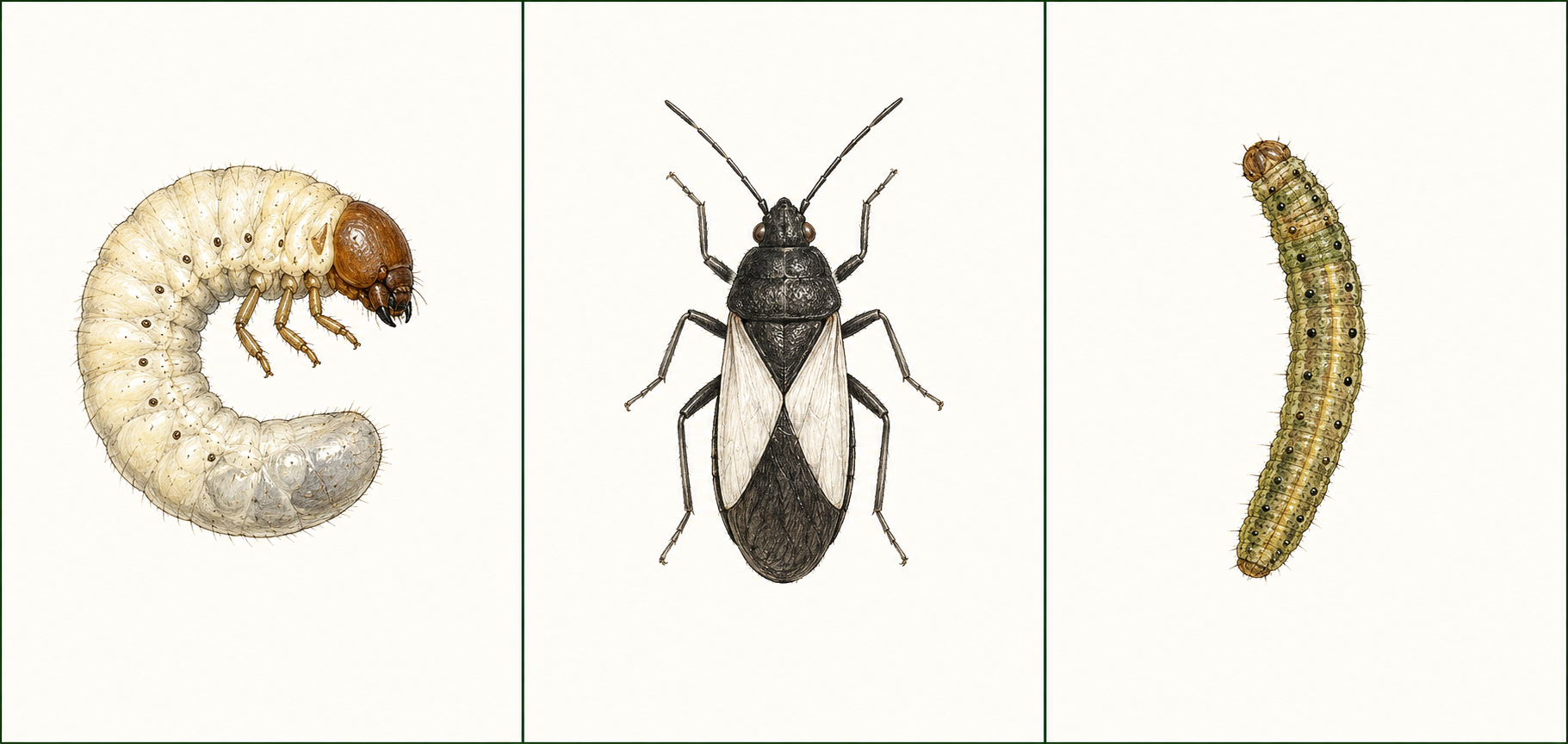
Common suspects
Know what you're looking for.
Use the searchable directory to compare insects, diseases and non-pest problems by turf type, symptom and physical characteristics.
Search Pest ID & RemediesBefore reaching for a product
Do not automatically increase irrigation.
Do not apply insecticide without finding an active insect.
Do not apply fungicide without reasonable evidence of disease.
Do not fertilize stressed turf to force recovery.
Do not combine products unless every label expressly permits it.
Do not treat near water, pollinators, pets or people contrary to the label.
Symptoms still overlap?
Professional evaluation is appropriate when decline spreads quickly, roots are damaged, multiple lawn areas fail at once, or identification remains uncertain.
Request a Lawn Evaluation