Florida nursery standards
Quality & grading
Sage recommends nursery material graded Florida No. 1 or better. The grade describes plant quality—not merely size—and should be verified together with the specified height, spread, clear trunk or container size.
- Specify Florida No. 1 or better nursery stock with a single sound trunk, symmetrical crown and healthy central spear.
- Confirm the palm is firmly rooted and that the root ball remains intact when handled.
- Reject specimens with trunk wounds, a loose root ball, collapsed spear, widespread leaf spotting or pronounced nutrient deficiency.
Installation guide
Planting for establishment
- Install at the same depth the palm grew in the nursery; never bury the root-initiation zone.
- Choose a sharply drained location and correct roof runoff or low-grade ponding before planting.
- Allow approximately five to seven feet from buildings and pools, three to four feet from walkways and at least six feet from screen enclosures.
- Stabilize only when necessary, without nails or climbing-spike wounds, and remove temporary supports after establishment.
Final planting depth, root-ball preparation, staking and irrigation should respond to the actual root system, soil, drainage and exposure observed on site.
Ongoing care
Water & fertilizer
Irrigation
Water the entire root ball and surrounding soil consistently during establishment, then lengthen the interval between deep applications as roots expand. Established palms are highly drought tolerant, but new installations in hot sand or reflected heat require attentive watering. Avoid shallow, frequent cycles and chronically saturated soil.
Fertilization
When site conditions and palm appearance indicate need, broadcast a controlled-release fertilizer formulated for Florida palms—with appropriate potassium, magnesium and complete micronutrients—uniformly over the root zone according to the label. Do not use high-nitrogen turf fertilizer as a substitute or place fertilizer against the trunk.
Correct technique
Pruning & trimming
- Remove only completely brown, broken or hazardous fronds and spent flower or fruit stalks when necessary.
- Preserve healthy green fronds and the natural open crown; never perform a hurricane cut.
- Never cut or damage the terminal growing point, and do not use climbing spikes or strip healthy trunk fiber for appearance.
Monitor before treating
Known pests & problems
Nutrient deficiencies
Discoloration patterns can overlap. Evaluate new and older foliage, irrigation and the complete fertilizer program before correcting a suspected deficiency.
Ganoderma butt rot
A conk or unexplained lower-trunk decline requires professional evaluation. There is no curative treatment once Ganoderma is confirmed.
Root and crown stress
Poor drainage, deep planting and establishment drought can mimic pest injury. Correct the site condition and confirm the cause before treatment.
Symptoms often overlap. Confirm the cause before applying pesticides or fertilizer, and always follow the product label.
Landscape application
Design guidance
Recommended uses
Compatible pairings
Important cautions
- Use reliably in Zones 10b–11; reserve Zone 10a planting for protected coastal or urban microclimates where cold injury is acceptable.
- High salt-air tolerance does not mean repeated saltwater flooding is safe for the root system.
- Its slow growth makes it unsuitable where rapid screening or immediate height is required.
- Do not place the crown where mature fan leaves will obstruct pedestrians, vehicles, roofs or screens.
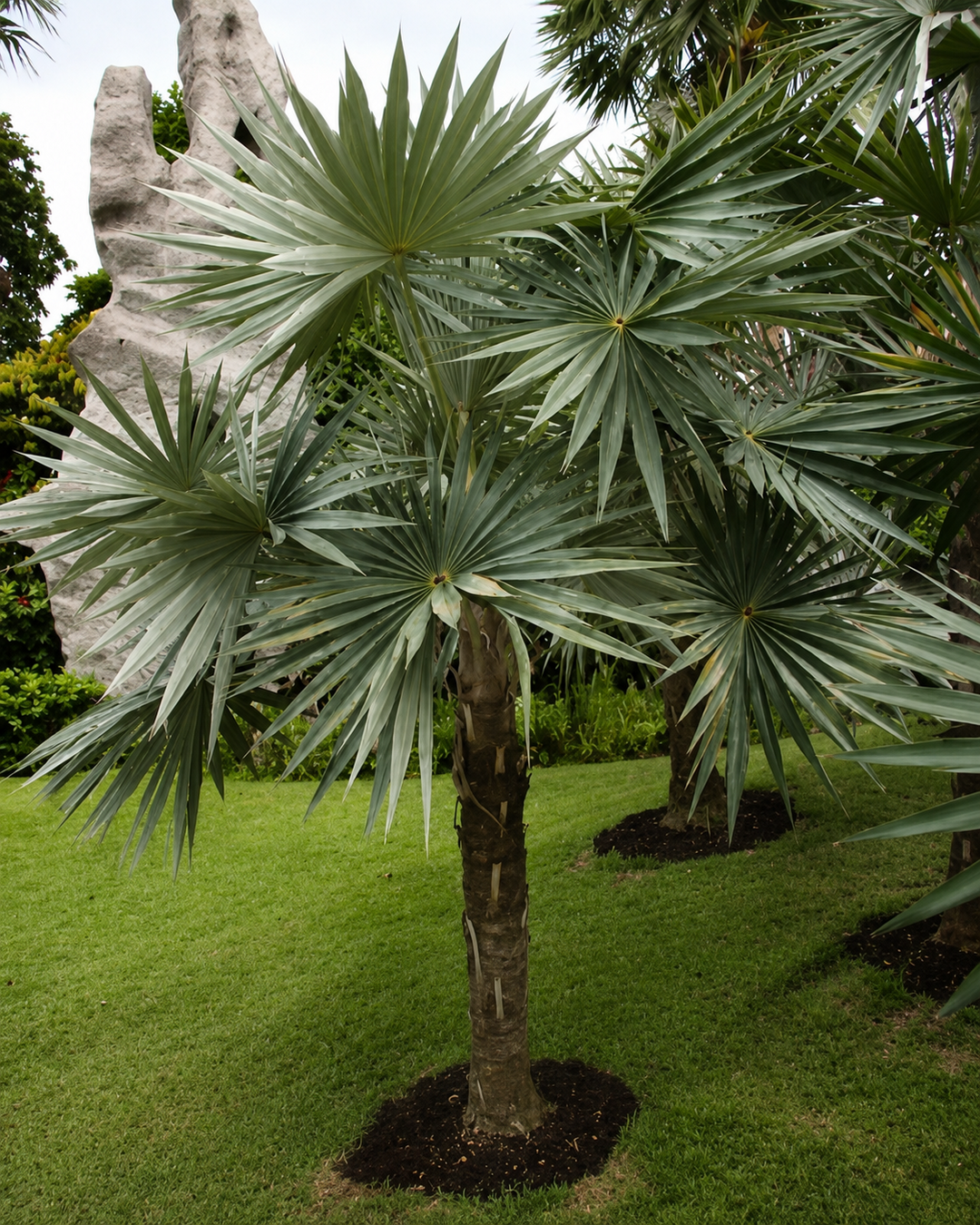
Sage professional observationFlorida silver palm is a strong answer when a design needs genuine coastal character at a restrained scale. We prefer it as a visible architectural specimen or repeated accent, where the silver leaf undersides can catch light and wind rather than disappear inside a dense hedge.
Reference framework
Standards & sources
Profile guidance is informed by the Florida Department of Agriculture and Consumer Services’ Grades and Standards for Nursery Plants, University of Florida IFAS horticultural guidance and Sage’s regional landscape experience.
Site conditions, product labels and professional diagnosis govern the final recommendation.