Florida nursery standards
Quality & grading
Sage recommends nursery material graded Florida No. 1 or better. The grade describes plant quality—not merely size—and should be verified together with the specified height, spread, clear trunk or container size.
- Specify Florida No. 1 or better and require the palm grade, clear-trunk height and overall height to be stated separately.
- Choose a straight, undamaged trunk, full green crown and firmly rooted specimen.
- Reject palms with trunk constrictions, deep wounds, spear-leaf decline, severe nutrient deficiency or unstable root balls.
Installation guide
Planting for establishment
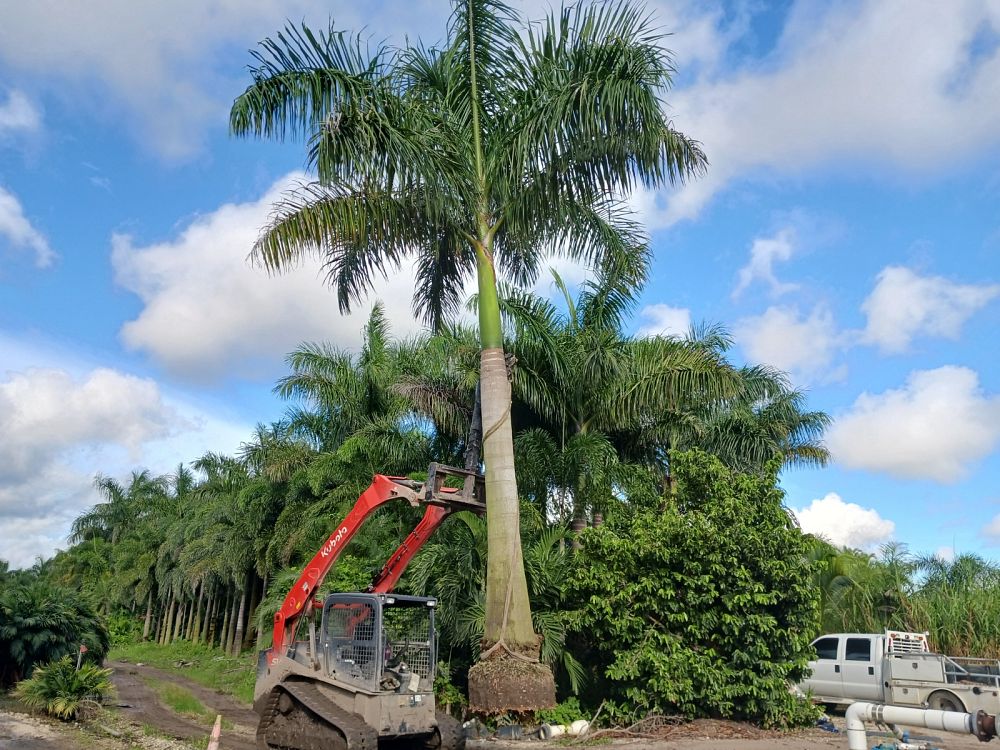
- Set the palm at the same depth it grew in the nursery; never bury the root-initiation zone.
- Provide a broad, well-prepared hole and stabilize the palm without driving nails into the trunk.
- Use temporary bracing only as needed and remove it after establishment.
- Maintain clear overhead and drop zones away from roofs, vehicles and pedestrian gathering areas.
Final planting depth, root-ball preparation, staking and irrigation should respond to the actual root system, soil, drainage and exposure observed on site.
Ongoing care
Water & fertilizer
Irrigation
Keep the transplanted root ball evenly moist during establishment without creating chronically saturated soil. Once established, royal palms perform best with reliable moisture but tolerate brief dry periods.
Fertilization
Use a controlled-release palm fertilizer formulated for Florida soils—commonly 8-2-12-4Mg or 8-0-12-4Mg with complete micronutrients—broadcast uniformly beneath and beyond the canopy as the label directs.
Correct technique
Pruning & trimming
- Remove only completely dead, loose or hazardous fronds and spent inflorescences where fruit litter matters.
- Never cut green fronds above a horizontal 9-to-3-o’clock line or perform a hurricane cut.
- Do not damage the crownshaft or trunk with climbing spikes.
Monitor before treating
Known pests & problems
Royal palm bug
Distorted or scorched emerging foliage warrants professional identification; damage occurs high in the canopy.
Ganoderma butt rot
There is no cure once confirmed; remove hazardous palms and do not replant another palm in the same location.
Nutrient deficiencies
Potassium, magnesium, manganese and boron symptoms can overlap; correct the entire fertilization program rather than spot-treating one symptom.
Symptoms often overlap. Confirm the cause before applying pesticides or fertilizer, and always follow the product label.
Landscape application
Design guidance
Recommended uses
Compatible pairings
Important cautions
- Large self-cleaning fronds can damage property or injure people.
- The massive mature scale is inappropriate beneath utilities or close to buildings.
- Cold injury is possible outside the warmest Gulf Coast microclimates.
Sage professional observationRoyal palms should frame architecture, not overwhelm it. On estate-scale sites, disciplined spacing creates a ceremonial rhythm that few other palms can match.
Reference framework
Standards & sources
Profile guidance is informed by the Florida Department of Agriculture and Consumer Services’ Grades and Standards for Nursery Plants, University of Florida IFAS horticultural guidance and Sage’s regional landscape experience.
Site conditions, product labels and professional diagnosis govern the final recommendation.