Florida nursery standards
Quality & grading
Sage recommends nursery material graded Florida No. 1 or better. The grade describes plant quality—not merely size—and should be verified together with the specified height, spread, clear trunk or container size.
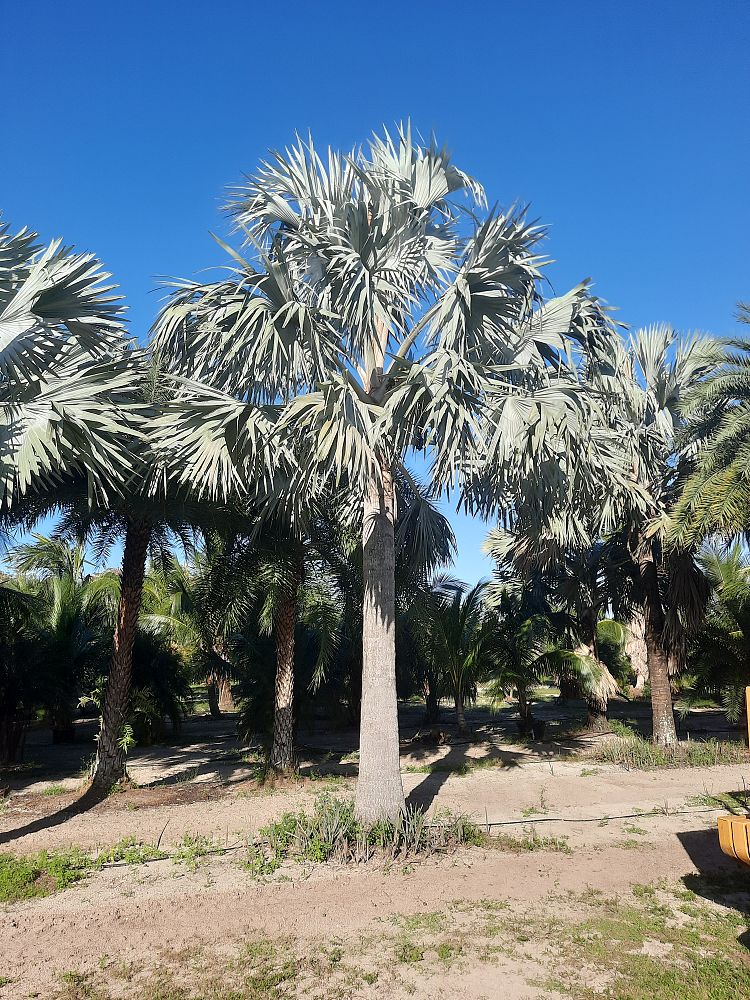
- Specify Florida No. 1 or better nursery stock with a symmetrical crown, healthy central spear, sound trunk and the desired intensity of silver-blue foliage.
- Evaluate the individual palm rather than relying only on a cultivar label because seed-grown specimens vary in silver color.
- For field-grown material, select palms that were professionally root-pruned and regenerated before digging.
- Reject palms with a loose or damaged root ball, trunk wounds, collapsed spear, extensive potassium-deficiency symptoms or evidence of severe transplant stress.
Installation guide
Planting for establishment
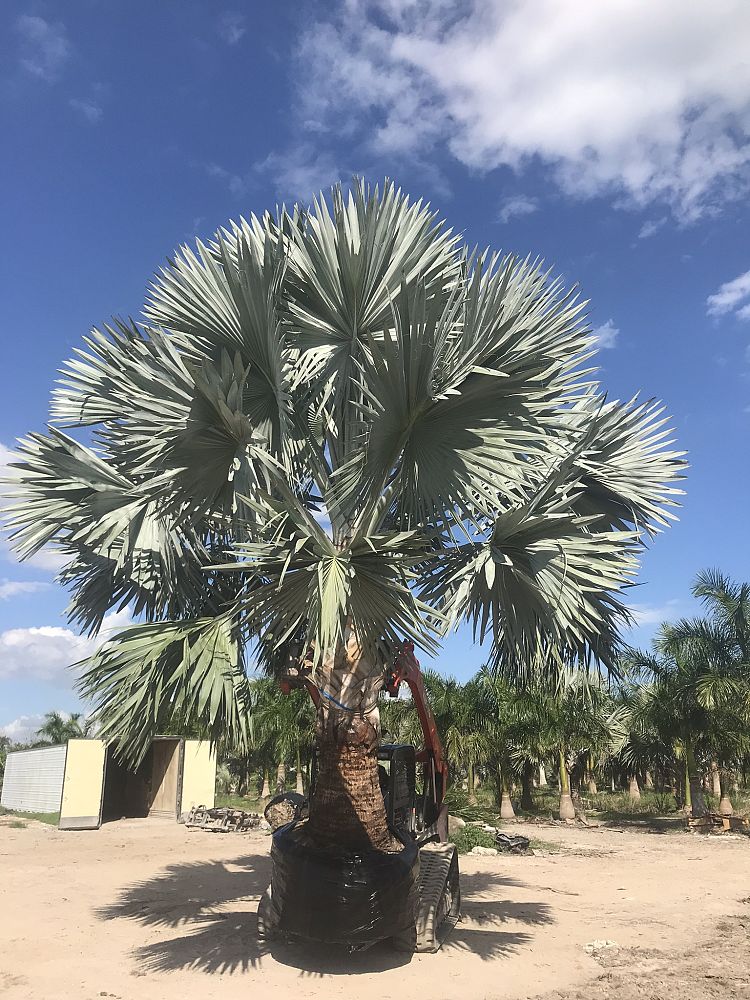
- Reserve a large, open location: allow roughly 10–12 feet from buildings, pools and screen enclosures, and keep the mature crown outside drives, walks and property lines.
- Never install beneath overhead utilities or in a narrow foundation bed; the mature crown commonly spans 12–16 feet.
- Set the root-initiation zone at the original nursery grade, preserve the root ball and prevent drying during transport and installation.
- Stabilize only when necessary without nails or trunk wounds, and provide deep establishment irrigation directly to the original root ball.
Final planting depth, root-ball preparation, staking and irrigation should respond to the actual root system, soil, drainage and exposure observed on site.
Ongoing care
Water & fertilizer
Irrigation
Keep the entire root ball and adjacent soil consistently moist—but never continuously saturated—during establishment. Lengthen the interval between deep applications as roots expand. Established Silver Bismarck Palms are highly drought tolerant, but newly transplanted field-grown specimens require precise irrigation and close monitoring.
Fertilization
Use a controlled-release fertilizer formulated for Florida palms, with appropriate potassium, magnesium and complete micronutrients, broadcast uniformly over the root zone according to the label. Potassium deficiency commonly produces yellow-orange translucent spotting, leaflet-tip necrosis and premature death of older fronds. Avoid turf fertilizer substitutes and do not remove affected older leaves while they remain substantially green.
Correct technique
Pruning & trimming
- Remove only completely brown, broken or hazardous fronds; preserve the broad natural crown.
- Never hurricane-cut, remove healthy leaves to narrow the canopy or cut fronds above the horizontal merely for appearance.
- Protect the terminal growing point, avoid climbing spikes and prevent unnecessary wounds that can attract pests.
- Lower large fronds carefully so they do not damage the trunk, surrounding plants, roofs, vehicles or paving.
Monitor before treating
Known pests & problems
Palmetto weevil
Bismarck Palms are highly attractive to this pest, especially after transplanting, cold injury or other stress. Sudden decline of new leaves or crown collapse requires immediate professional evaluation; advanced damage is commonly irreversible.
Ganoderma butt rot
This fatal disease decays the lower trunk and may cause instability. A shelf-like conk may or may not appear. There is no curative treatment once infection is confirmed.
Nutrient deficiencies
Potassium is the most frequent concern; magnesium, manganese and boron deficiencies can also alter foliage or prevent spear leaves from opening correctly. Diagnose the pattern before correcting it.
Symptoms often overlap. Confirm the cause before applying pesticides or fertilizer, and always follow the product label.
Landscape application
Design guidance
Recommended uses
Compatible pairings
Important cautions
- This palm can overwhelm a small residential landscape and is exceptionally difficult to relocate after establishment.
- UF/IFAS notes that Bismarck Palm is not as resistant to windstorm damage as many other palm species.
- Moderate salt-spray tolerance does not make it appropriate for repeated saltwater flooding or the most exposed beachfront sites.
- Cold injury becomes a concern near 30°F; Zone 9b use should be limited to protected sites where damage or loss is acceptable.
- Do not control an undersized planting space through chronic over-pruning—select a smaller palm instead.
Sage professional observationA Silver Bismarck should be treated as permanent landscape architecture. We place it where the entire crown can be viewed, illuminated and allowed to mature without fighting the house, circulation or neighboring property. Given that space, one excellent specimen can organize the whole composition.
Reference framework
Standards & sources
Profile guidance is informed by the Florida Department of Agriculture and Consumer Services’ Grades and Standards for Nursery Plants, University of Florida IFAS horticultural guidance and Sage’s regional landscape experience.
Site conditions, product labels and professional diagnosis govern the final recommendation.